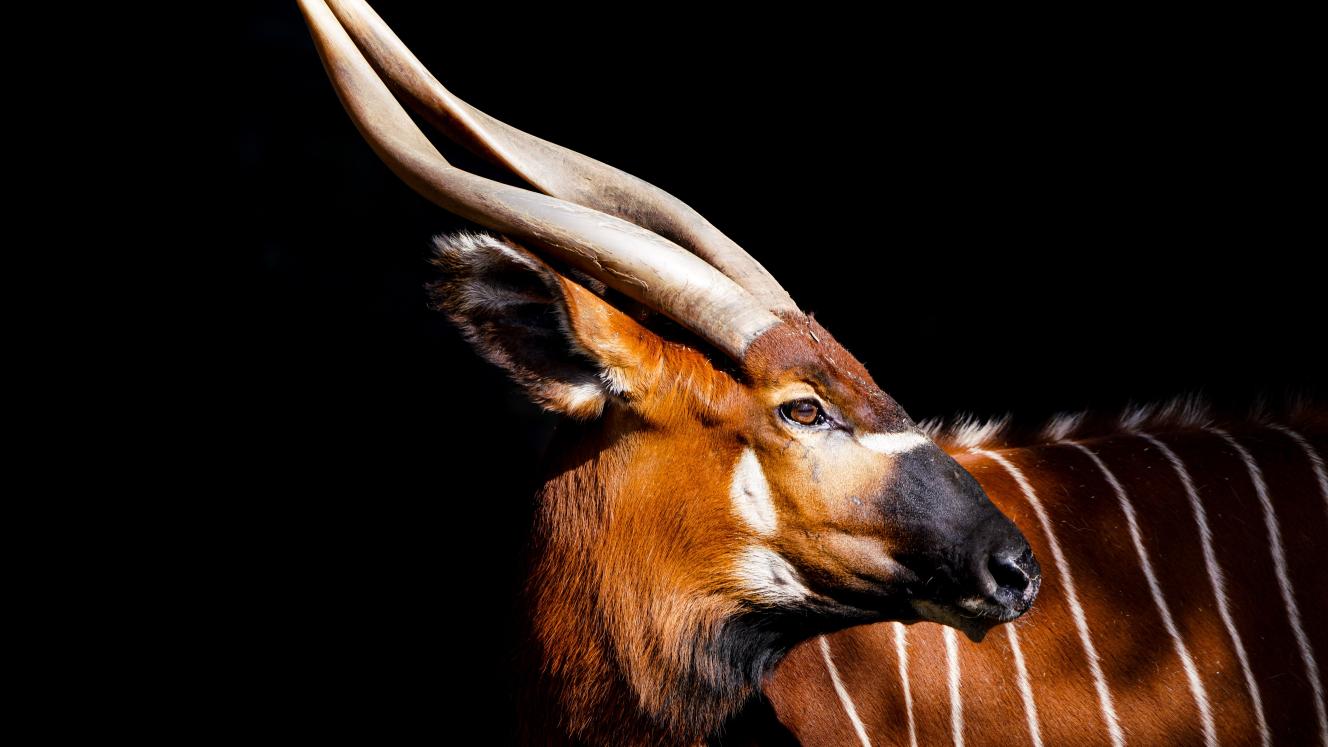
Camera traps deep in the Maasai Mau forest have delivered one of Kenya conservation’s more hopeful data points in recent years: continued confirmation of mountain bongo, one of the world’s rarest antelope, still holding on in the forest.
A 2023 study in the journal Oryx, led by researcher Tommy Sandri, used mark recapture analysis of historical camera trap records to estimate, for the first time, actual population numbers for the species’ two breeding strongholds: the Aberdares and the Maasai Mau forest.
The combined total came in at somewhere between 18 and 51 individuals, a sobering number for a subspecies once counted in the hundreds across Kenya’s highland forests.
Although mountain bongos were thought to have since disappeared from parts of Kenya’s Mau Forest Complex, in late 2025 and early 2026, camera traps in Maasai Mau revealed that a small population survived there, including an adult male, a younger male and a young female.
This rediscovery begs the question: Given how directly the Mara and Serengeti’s enormous tourism economy depends on the Mara River, and that the river’s health is closely linked to the forested catchment of the Mau, should more tourism operators profiting from that ecosystem be investing in protecting the forest?
The bongo’s rediscovery offers a hook: a charismatic, critically endangered species that could reframe the conversation and push tourism businesses to match their conservation branding with action.
Communities must benefit
Oscar Dyer, Director of Operations at the Mountain Bongo Project, thinks the underlying premise of this proposition is sound but with caveats. “I do think carefully managed tourism could generate meaningful value for the protection of the forest and its threatened species,” he says, pointing to the Aberdares as proof of concept: visitors already travel specifically to places like Rhino Retreat for the chance to see mountain bongo, generating tourism value tied directly to the species’ survival.
The Maasai Mau, though, is a different proposition, he stresses, as it is a county forest and the communities living around it have a direct stake in its future so any tourism model built around the bongo needs to be far more carefully designed than a simple wildlife viewing product.
“Any tourism model would therefore need to be developed very carefully with clear benefits flowing not only towards forest protection but also to the communities living around it,” Dyer says.
A working model
There’s perhaps a working template nearby even if not yet in the Maasai Mau. Governors’ Camp Collection has spent recent years channelling tourism revenue into the Eburru section of the wider Mau Forest Complex, the same landscape where mountain bongo have likely already vanished.
The company has supported the community organisation Eburru Rafiki’s tree planting programme, funding around 4 170 indigenous seedlings tended by local forest association members over three-year cycles, and backs alternative livelihoods for the Ogiek, one of Africa’s last forest dwelling communities, by purchasing their forest-harvested honey for use at its own Loldia House property.
Guests are guided through the forest by Eburru Rafiki escorts to see buffalo, duiker, bushbuck and colobus. Although it’s not a bongo tourism product, it serves as a working example of tourism revenue flowing into forest protection and community livelihoods within the same broader ecosystem including the Maasai Mau.
Governors’ Camp Collection focuses its conservation efforts on Eburru Rafiki, says Alisa Karstad, the company’s Impact Manager, but is very interested in the ongoing discussions about reintroducing mountain bongo to Eburru. “It is of great interest to us from a tourism and conservation point of view. A return would be of huge significance not only for the conservation of one of Kenya’s most endangered mammals but because it could help reinforce protection of the wider forest ecosystem.”
Karstad understands that any bongos would first be held in an area at the edge of the forest for acclimatisation – perhaps in a similar way to the bongos currently living at the Mount Kenya Wildlife Conservancy. That would offer visitors a wonderful opportunity to see a critically endangered species and hopefully drive further conservation efforts, she says.
The mountain bongo population is small and the community stakes are high. But the ingredients – a flagship endangered species, an established downstream tourism economy with an obvious commercial interest in the forest's survival and at least one working example of tourism-funded conservation elsewhere in the same landscape – suggest the opportunity is real if operators are willing to put resources behind it.