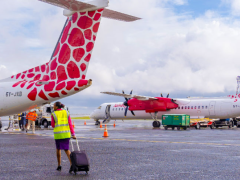
For the first time, Cape Town International Airport reported a total of more than 10 million arriving and departing passengers, with King Shaka International Airport recording a total of more than five million passengers for the first time.
This is according to Airports Company South Africa’s (Acsa) latest financial results for the year to March 31, 2017
Acsa reported revenue growth of 3.4% to R8.6 billion (€540 million), with profit up 10.8% to R2 billion (€125 million).
Return on equity was 11.3% compared with 11.5% in the previous period. Capital expenditure reduced by 31.3% to R893 million (€56 million).
Bongani Maseko, CEO of Acsa, said the company continued to be “resilient, despite sluggish economic growth”.
While domestic passenger growth was subdued at 2.2%, Acsa reported strong growth of 6.1% in international departing passengers.
Aircraft landing volumes were flat for domestic flights and up by 2.5% for international flights, indicating higher passenger utilisation of scheduled flights.
Maseko noted that Acsa had managed to significantly reduce its debt levels over the past five years. Debt, primarily in the form of bond issues, stood at R9 billion (€566 million) at the end of the period, significantly down from R17 billion (€1 069 million) in 2012. As a result, the company’s gearing ratio has reduced from 59% in 2012 to 25% in the 2017 financial year.
Aeronautical revenue contributed 63% to total revenue but the company remains committed to continue to grow the non-aeronautical revenue contribution. Non-aeronautical revenue is derived from sources such as retail space, advertising, office rental, parking and car hire.
“The overall financial position of the company therefore remains healthy, despite regulatory uncertainty and difficult economic conditions,” said Maseko.
“Operationally, we are adapting well to a new tariff regime from the regulator which required a 35.5% reduction for the 2018 financial year with increases in the following two years of 5.8% and 7.4%,” he said.
Acsa met 76% of its performance objectives in the period under review, which for the first time included additional measures such as reducing environmental impact, improving connectivity to the regions served, providing equitable access to safe airports, and leadership culture.
“We now have 17 measures of performance that underpin our three-pillar strategy to run airports, develop airports and to grow our footprint. This ensures that the drivers of performance are moving us in the desired direction and that all employees understand how they make a difference,” said Maseko.