Researchers have produced a series of giraffe distribution maps in a new study covering 21 range countries in Africa which they say presents a more accurate picture of where the animals live.
The study, titled ‘Updated geographic range maps for giraffe, Giraffa spp., throughout sub-Saharan Africa, and implications of changing distributions for conservation’ was first published in August this year.
About 70% of giraffes’ range occurs outside government-managed protected areas, or formally protected areas like national parks. This means that most giraffe populations live on community lands, sharing space with livestock and people, the study found.
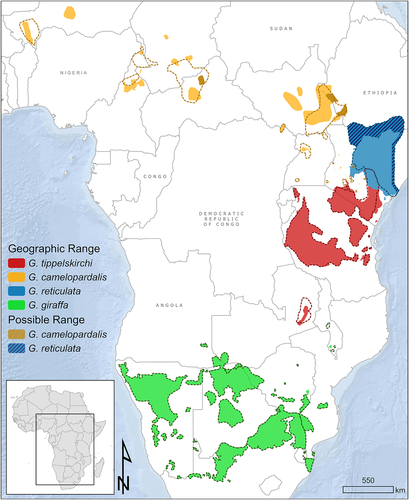
Updated geographic range maps for giraffe in sub-Saharan Africa. Image courtesy of O’connor et al. (2019).
The study combined the latest data from on-the-ground and aerial surveys, following movements of GPS-tagged animals, consultation with experts, and reviewing the scientific literature.
The updated maps from the study will serve as a baseline from which conservationists can now start monitoring changes in giraffe distribution in the future, the researchers say.
The researchers used various data, including those from large-scale aerial surveys such as the Great Elephant Census which counted African savanna elephants (Loxodonta africana) and other large mammals where?, including giraffe. This produced comprehensive and accurate maps of where giraffe populations live in sub‐Saharan Africa.
The maps show that the northern giraffe’s populations occur in small, fragmented populations, with their decline driven largely by the loss of habitat. The maps also show an expansion in the distribution of the Reticulated giraffe, more than previously thought, but this is probably because of improved monitoring and data collection.
“Government-managed protected areas setting aside pieces of land for wildlife is critical, and that’s really helpful for preserving habitat, but to really conserve giraffe we will have to work directly with the people that are living alongside these animals,” Jenna Stacey-Dawes, a co-author of the study and researcher at San Diego Zoo Global said. “That’s the kind of model that we’re working with in northern Kenya with Reticulated giraffe, where over 95% of their distribution occurs outside these formerly protected areas.”
For four countries, including eSwatini (formerly Swaziland), Namibia, Somalia and South Africa, the researchers weren’t able to get sufficient data. In Somalia, this is because there hasn’t been any systematic survey on giraffes due to ongoing conflict and insecurity, said Julian Fennessy, co-author of the study and co-founder of the Giraffe Conservation Foundation. In Namibia and South Africa, which have some of the largest populations of giraffe, there is another challenge: most giraffes live outside protected areas on private land, from where getting an accurate count is especially hard.
This is a shortened version of the original article from Mongabay, see here.