
While South Africa’s inbound tourism recovery continues to strengthen, with total arrivals in March above pre-pandemic levels, performance across overseas source markets remains uneven.
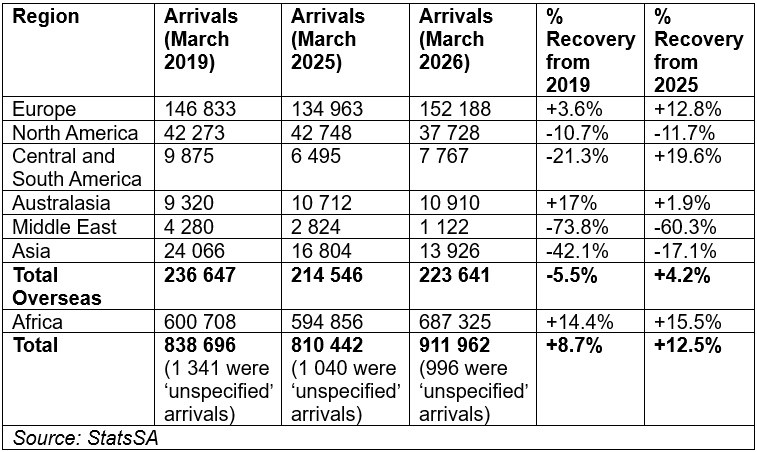
According to the latest International Tourism Report from Statistics South Africa (Stats SA), total arrivals reached 911 962 in March 2026 – a 12.5% increase on March 2025 and 8.7% higher than March 2019.
However, this overall growth is again largely underpinned by Africa, which recorded 687 325 arrivals in March – a 15.5% increase on 2025 and 14.4% higher than 2019.
In contrast, total overseas arrivals reached 223 641, reflecting a 4.2% increase on 2025 but still 5.5% below 2019 volumes.
Europe remains South Africa’s strongest overseas source market and outperformed pre-pandemic levels. Arrivals reached 152 188, reflecting an increase of 3.6% on 2019 levels and 12.8% higher than 2025.
The Americas show a more mixed performance. North America remains slightly below recovery benchmarks with arrivals down by 10.7% on 2019 levels and 11.7% lower than 2025. In contrast, Central and South America are showing stronger momentum, up 19.6% from 2025, although still 21.3% below 2019 levels.
Australasia is one of the stronger performing long-haul regions with arrivals increasing by 17% on 2019 levels and a marginal 1.9% increase on 2025.
Asia’s recovery is significantly behind at 42.1% below 2019 levels and 17.1% below 2025.
The Middle East lags the most with arrivals down by 73.8% on 2019 and 60.3% on 2025.
Here is the full breakdown:
First quarter 2026
StatsSA’s first quarter (Q1) stats show that South Africa’s total arrivals for January to March 2026 were up by 12.4% compared with the same period last year – increasing from 2.5 million to 2.9 million.
Total overseas arrivals increased by more than 40 000 (from 641 085 to 681 677) – a 6.3% rise.
David Frost, SATSA CEO, said South Africa’s latest Q1 2026 overseas arrivals data gives the tourism industry reason to be encouraged but it also presents an important opportunity to change the way tourism performance is read.
“For too long, tourism recovery has been framed largely through year-on-year or month-on-month growth. These indicators are useful but they do not always tell us enough. Growth off a low base can look impressive while a market may still remain materially below its pre-pandemic strength. Similarly, strong topline arrivals can mask uneven performance across source markets, shifts in traveller behaviour or growing exposure to airfare and economic pressure,” he said.
South Africa has recorded its strongest Q1 arrivals performance since 2019 with overall recovery now 95.2% of pre-COVID levels.
“This is an important milestone for an industry that has worked exceptionally hard to rebuild demand, restore confidence and reposition South Africa competitively. It reflects the resilience of tourism businesses, the strength of South Africa’s destination appeal and the continued work being done across the tourism value chain,” said Frost.
However, Q1 is also traditionally one of South Africa’s peak travel periods when stronger topline performance is expected. The real measure will be whether this recovery can be sustained through the rest of the year, particularly against the backdrop of geopolitical uncertainty, airfare pressure and shifting traveller confidence.
“We should absolutely recognise the progress reflected in the Q1 numbers but we also need to be disciplined in how we interpret them. Year-on-year growth is not the same as full recovery and full recovery is not the same as future competitiveness. The real value lies in understanding which markets are growing, which remain under pressure and where South Africa has the strongest opportunity to unlock additional demand,” added Frost.
As South Africa edges closer to full recovery, Frost suggested the next phase will require sharper market intelligence, stronger coordination and a willingness to act quickly where the data shows either opportunity or risk.
“We need to keep strengthening established markets, rebuild those that remain under-recovered and develop new source markets with greater urgency. This will require multiple levers working together, including visa facilitation, air access, destination marketing, trade engagement and continued private-public collaboration.”
Insights into March
Industry analysts believe external geopolitical and economic pressures played a significant role in shaping March’s performance.
Martin Jansen van Vuuren, MD of Futureneer Advisors, told Tourism Update that the conflict in the Middle East and disruption to major transit hubs had a direct impact on long-haul arrivals.
“The obvious culprit for the results in March was the conflict in the Middle East and the disruption to the transit hub of Dubai, Abu Dhabi and Doha. This had a significant impact on arrivals from the Middle East and Asia in particular.”
He warned that related future impacts may be an increase in fuel prices and the introduction of jet fuel surcharges by airlines.
Geopolitical tensions are also weighing on demand from the US market.
“Arrivals from the US will continue to be impacted by the actions of President Trump towards South Africa. This has led to a cautionary travel advisory to Americans travelling to South Africa,” said Jansen van Vuuren.
He also pointed to currency movements as a factor. “The South African rand has also strengthened against world currencies, effectively making South Africa more expensive.”
However, Jansen van Vuuren highlighted the role of positive destination marketing through major events.
“Positive impacts that should not be underestimated include the marketing South Africa received from sporting events such as the LIV Golf event at Steyn City. This positive marketing can be built on with the Rugby's Greatest Rivalry tour and the Australian cricket tour, to name but a few.”
Lee-Anne Bac, Advisory Partner: Tourism at BDO South Africa, said she is amazed by the strength of Europe’s performance in March, adding that this suggests strong uptake of direct flights.
Bac highlighted strong growth from Brazil and the wider South American market, attributing this to improved air access and the absence of reliance on Middle Eastern transit points. She said this reinforced the importance of South-South travel, which she believes should be a greater focus for South Africa.
She also pointed to continued strength in Australasia, particularly driven by visiting friends and relatives travel, although she suggested some travel demand from markets such as New Zealand may be delayed to later in the year when the All Blacks come to South Africa for Rugby’s Greatest Rivalry.
For Asia, Bac raised concerns about the lack of recovery from key markets such as China and India despite policy interventions. She said the decline (China down 39% and India down 42% on March last year) was partly linked to connectivity challenges and traveller reluctance to transit through conflict-affected regions.
“It’s hugely concerning to me that we’re not seeing an impact of the Electronic Travel Authorisation or the Trusted Tour Operator Scheme on these markets,” Bac added.
She believes the sharp decline in Middle East arrivals was expected, given the scale of disruption, but emphasised that the region remains a relatively small source market.
Bac also noted continued strength across African markets beyond cross-border travel with countries such as Nigeria, Kenya and the Democratic Republic of the Congo showing solid growth.
Looking at airport arrivals in March, Bac said, despite the challenges in the Middle East, OR Tambo International Airport had a 7.3% increase in overseas arrivals compared with March 2025 – the biggest increase so far this year (in February it was 4.8% and in January 5%).
Cape Town International Airport had a 2.5% increase in March compared with the same period in 2025 (in February it was a 2.6% increase and a 13% increase in January). Cape Town also had a commendable increase in arrivals from Africa with nearly 14% in March.
Durban’s King Shaka International Airport, however, recorded a sharp decline in overseas arrivals, reflecting its reliance on Middle Eastern carriers such as Emirates and reduced flight capacity, said Bac. The airport’s overseas arrivals were down by 72% in March compared with last year.