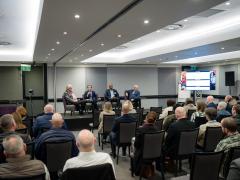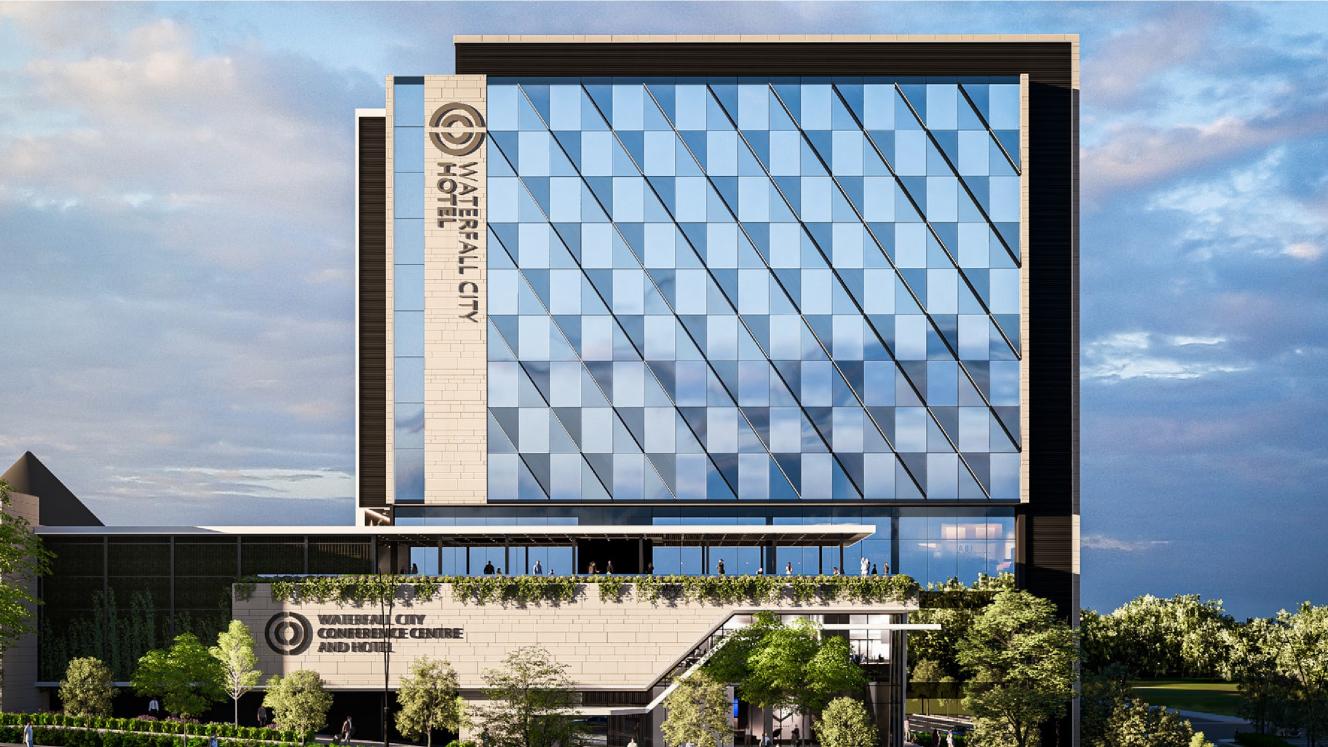
Following the announcement of the new Waterfall City Conference Centre and Hotel development, African Rain Collection CEO Gary Koetser spoke to Tourism Update Managing Editor Sue van Winsen about the thinking behind the project and why the Waterfall precinct emerged as the preferred location for the group’s first major expansion into the Johannesburg market.

Demand from corporate clients for a Johannesburg venue comparable to Century City Conference Centre was a key driver behind the development, Koetser said. “Our clients were telling us that there’s nothing of similar nature in Johannesburg.”
The project was first explored before the pandemic but was paused until after the MICE sector recovered. Discussions with developers resumed and Waterfall City again emerged as the preferred location.
“Waterfall City was always the ideal location,” Koetser said. “A city within a city, it’s got safety, it’s central and it’s on a major highway so there’s easy access between Pretoria and Johannesburg. And a lot of the big corporates are already there.”
Koetser said proximity to major corporate tenants within the precinct was a major consideration in selecting the site while direct pedestrian access to the Mall of Africa was another deciding factor, particularly for association conferences.
“What we found in Cape Town is that, when people attend conferences, they want to do a little bit of shopping, especially delegates at African association conferences.”
The development will also form part of African Rain Collection’s broader approach to embedding a stronger sense of place within its conferencing environments, particularly for international association events, Koetser added.
International associations have told him: “We love your conference centre, we love everything but we could be anywhere in the world.”
The group has increasingly incorporated South African art, music, uniforms and locally inspired food into its venues as part of creating a more distinctly African conference experience.
The development will connect directly to existing mall parking infrastructure, allowing the venue to make use of approximately 800 bays already available on site.
“Our conferences are mostly Mondays to Fridays and those parking bays are mostly used on a Friday, Saturday and Sunday. So it works beautifully for all parties.”
Precinct control key to feasibility
Koetser said large-scale conference developments depend heavily on working within precincts where developers control surrounding infrastructure and land use – a common link between its Century City developed by Rabie Hospitality Group and Waterfall City developed by Attacq.
“I think what’s most common is that you’ve got developers that control the development of the whole node,” he said.
This allows long-term planning certainty and reduces the risk of competing venues being introduced into the same precinct shortly after opening.
“They’ve agreed that they won’t open another conference centre within Waterfall in the next five years,” Koetser said.
Infrastructure readiness
Beyond accessibility and corporate proximity, he said operational infrastructure such as structured parking access, generator capacity and water backup systems are essential factors in site selection.
“These sorts of basics are key to the success of the conference centre,” Koetser said.
The development includes provision for several days of backup water capacity as well as generator infrastructure positioned off-site to minimise noise disruption for hotel guests.
Event planner feedback
Koetser said the venue’s design has also been shaped by feedback from organisers rather than delegates alone.
“What I’ve come to realise, in the past 10 years, is that the back of house in a conference centre is almost more important than the front of house,” he said.
“If it’s not easy to use for event organisers, no matter how good the front of house is, the service, the food, they won’t use you.”
Features such as efficient service access routes, rigging infrastructure and loading logistics were incorporated early in the planning process to ensure the venue meets organiser expectations, Koetser pointed out.
Hotel demand
He said lack of sufficient hotel capacity within the Waterfall precinct also strengthened the case for the development.
“You need a hotel for the corporates in the area. That’s a massive challenge at the moment.”
The group also holds first right of refusal on a site opposite the conference centre development where a second hotel could be developed in future to further support conferencing demand in the node, Koetser added. Plans under consideration include a pedestrian skybridge linking the sites to allow easy delegate movement between the hotel and conference facilities.
Construction of the initial hotel and conference centre is expected to begin in May with completion targeted within an 18-month build programme ahead of the planned January 2028 opening.