South Africa ended 2025 with its highest-ever annual tourist arrivals but more work needs to be done to recover arrivals from overseas markets, which are still 8.5% behind pre-COVID 2019 levels.
Total arrivals for the year stood at 10.498 million, exceeding 2018’s previous record high of 10.472 million, according to Statistics South Africa’s latest International Tourism Report.
However, overseas arrivals – despite recording a solid year-on-year growth of 12% from 2024 – are at 91.5% of 2019.
“South Africa’s inbound tourism recovery is progressing, but it remains incomplete and less robust than recent headline narratives suggest,” said SATSA CEO David Frost.
Frost said that measured against the peak overseas arrivals year of 2017, current performance represented an 88% recovery.
“Framing current performance as a historic achievement risks overstating progress and obscuring the reality of where the sector truly stands.”
Source market regions that exceeded 2019 figures in 2025 included North America, Australasia and the Middle East with recovery rates of 104%, 113% and 108% respectively.
Europe, the largest overseas source market region, enjoyed an accelerated growth rate of 12.9% from 2024 but remained at 91% of 2019.
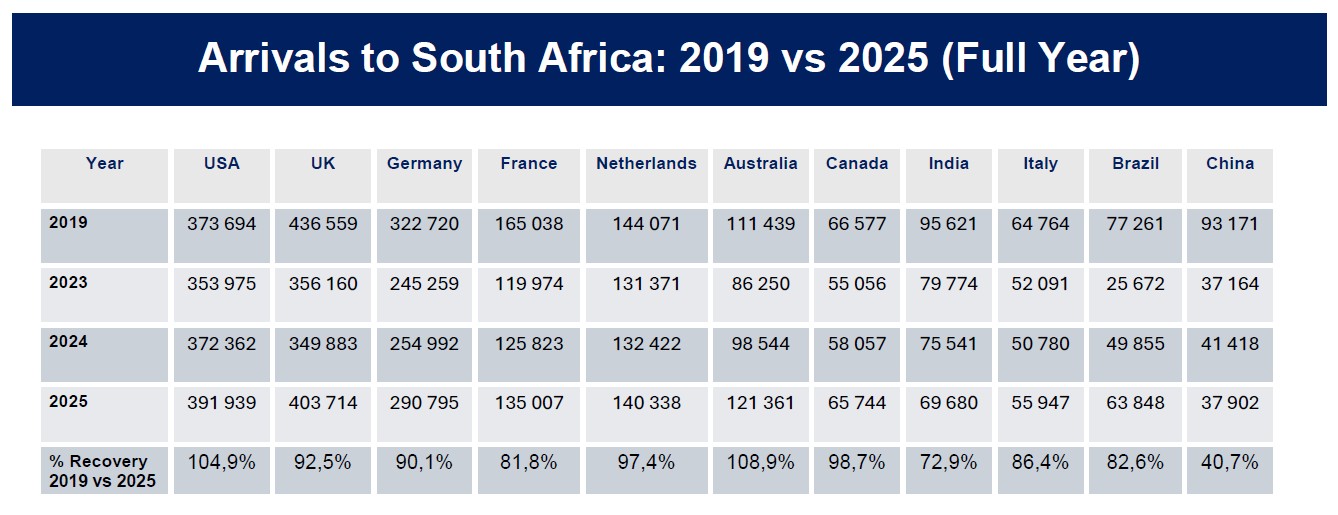
Lee-Anne Bac, Advisory Partner: Tourism at BDO South Africa, pointed out that the prevailing geopolitical environment led to the UK again overtaking the US as South Africa’s top overseas source market in 2025. 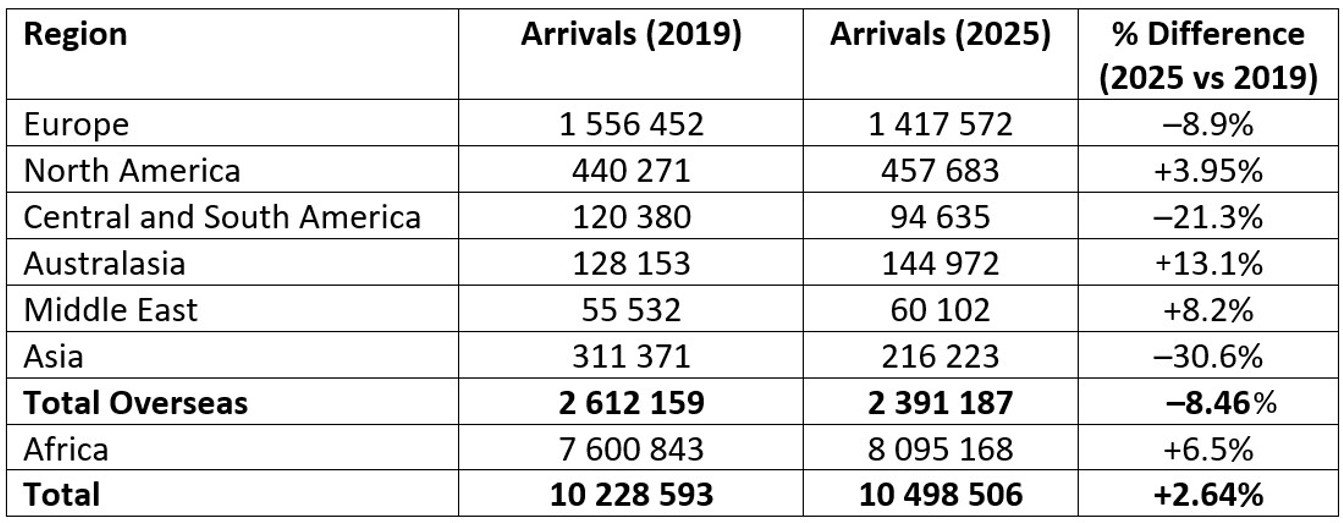
“The rand has strengthened significantly against the dollar, and the UK’s stabler geopolitical environment and stronger traveller confidence in South Africa is resulting in a welcome rebound in arrivals,” she said.
Despite strong year-on-year growth of 26% in 2025, the Central and South American market was at 79% recovery while Asian arrivals – which only grew by 4% year-on-year – were at 69% recovery.
Bac said that, when analysing average traveller spend figures from SA Tourism, the net economic loss from the missing chunk of overseas travellers totalled R5 billion (US$314.3 million).
Underlying challenges
Frost added that headline year-on-year growth figures further masked underlying structural challenges.
“Recovery remains uneven across source markets and regions. South Africa continues to lose ground relative to competing long-haul and African destinations, and market share, not absolute numbers alone, is the true measure of recovery.”
He said that longstanding concerns of possible double-counting of US tourists who exit South Africa for travel to other Southern Africa destinations and then return, remained unresolved.
“Without a formal statistical audit, this continues to skew the data and limits a clear assessment of true performance.”
He described the lacklustre performance of the Chinese and Indian markets as “the greatest concern”.
“Nearly a year after the introduction of the Trusted Tour Operator Scheme, recovery from both markets has stalled. This highlights a disconnect between policy announcements and effective market-facing execution.”
Frost singled out the introduction of the ETA, along with the success of air access initiatives driven largely by provincial bodies such as Wesgro’s Cape Town Air Access and Gauteng Air Access, as bright spots for the sector.
De Lille's claims challenged
Speaking at a media briefing in Pretoria on Tuesday, January 27, Tourism Minister Patricia de Lille attributed the recovery in total arrivals to “deliberate policy choices, focused implementation and strong collaboration between government and the private sector”.
Frost directly counteracted this assertion:
“Claims that current performance is the result of deliberate policy choices and strong public-private collaboration are difficult to reconcile with industry experience. Structured engagement with the private sector has been limited, with few sustained initiatives beyond efforts to stabilise Africa’s Travel Indaba via an advisory group and initial discussions on China and India during November 2025.”
Frost said that ongoing collaboration was severely challenged by the current leadership and governance issues at SA Tourism.
“The private sector remains ready to play a more active role in rebuilding South Africa’s inbound tourism performance. Meaningful collaboration, however, requires transparency, continuity and credible leadership. In the absence of stable governance and executive structures within SA Tourism, industry is left asking a fundamental question: who do we engage with to move from intent to execution?”
He stressed that through the TBCSA, the private sector was developing practical, market-ready initiatives, including strategic use of TOMSA levies to support targeted marketing in both traditional and growth markets.
“Inbound tourism does not respond to short-term interventions. What we see in the data today reflects decisions taken, or not taken, 18 months ago. Without clear, market-specific strategies implemented well in advance, progress will remain slow and incremental.”