Two of Sub-Saharan Africa’s strongest unserved routes still have no direct flight: Johannesburg to Mumbai and Brussels to Cape Town. Both appear in the Airbus Exploring the Horizons study among high-demand corridors where passengers continue to route through a third city because no carrier has yet launched a service.
Some of the continent’s connectivity gaps have narrowed over the past year. Qantas added Perth to Johannesburg, Edelweiss introduced its A350 service to Windhoek, Air Congo announced a Brussels link to Kinshasa and Ethiopian secured approval to serve Mauritius. If those routes can move from proposal to operation, why do others with similarly strong demand remain unserved?
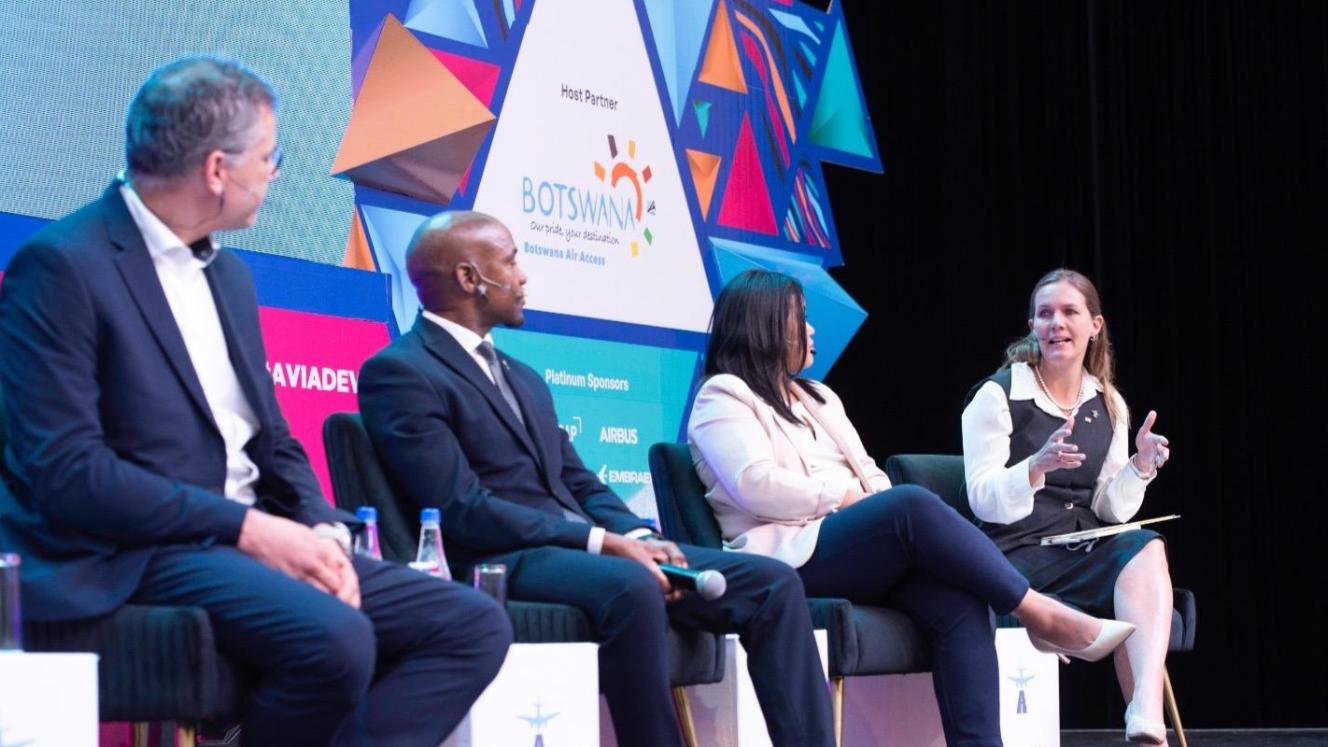
That question was at the centre of a discussion at AviaDev Africa 2026 in Gaborone where airlines, airports and tourism bodies met to build new air links. It was chaired by Natalia Rosa, Project Lead for the Southern Africa Tourism Alliance (SATA).
Airlines carry the risk
The panel agreed that none of the stakeholders can make a route work alone. Airports need traffic, tourism boards need visitors and airlines need confidence that travellers have a reason to come. Rosa described it as a relationship. But Keira Langford-Johnson, Business Development Director at Proflight Zambia, pointed out it is not equal as the airline carries the risk committing aircraft, crew and operating costs long before it knows that demand will materialise.
Those costs do not move with the load. Half-empty and full aircraft burn much the same fuel and no marketing campaign can change that. Airlines therefore look for evidence that demand will persist beyond a route launch. What they need, Langford-Johnson said, is proof that the market is self-sustaining after the initial excitement fades. Too often that evidence never reaches the table. “What are people doing after they arrive? Where do they go? How do they move? That’s the data that builds a route,” she said.
Data outweighs passenger numbers
Rupert Kraus, Director: Network and Partnerships at Discover Airlines, said passenger numbers alone are rarely enough to justify a new route. Just as important are broader indicators of growth: hotels being developed, cargo volumes increasing and new industries investing in a destination. “If I only looked at the data in front of me, I’d struggle to justify the route,” he said.
With a limited fleet and a growing list of potential destinations competing for capacity, airlines need confidence that a market can support service over the long term rather than generate short bursts of demand.
The data exists, Kraus argued, yet it remains fragmented. Road transfer operators, charter companies and tourism businesses already collect much of the information airlines need to assess whether a route can succeed: who is travelling, where they are going, when they are travelling and in what numbers. Together, those datasets provide a far richer picture of demand than airlines often receive.
Langford-Johnson illustrated the point with three of Proflight Zambia’s recent routes into Livingstone, Maun and Windhoek, which all emerged from conversations at AviaDev. None were obvious additions to the network but what changed was the preparation. Airport authorities, tourism boards and regulators arrived with a 72-page business case covering demand, market potential, operating costs and demographics. When information was missing, the airline asked for it and the partners supplied it. “If you’re not exchanging something, it’s just a meeting,” she said. The partners brought the evidence, helping build the confidence Proflight needed to launch the route.
The panel recording can be viewed here.