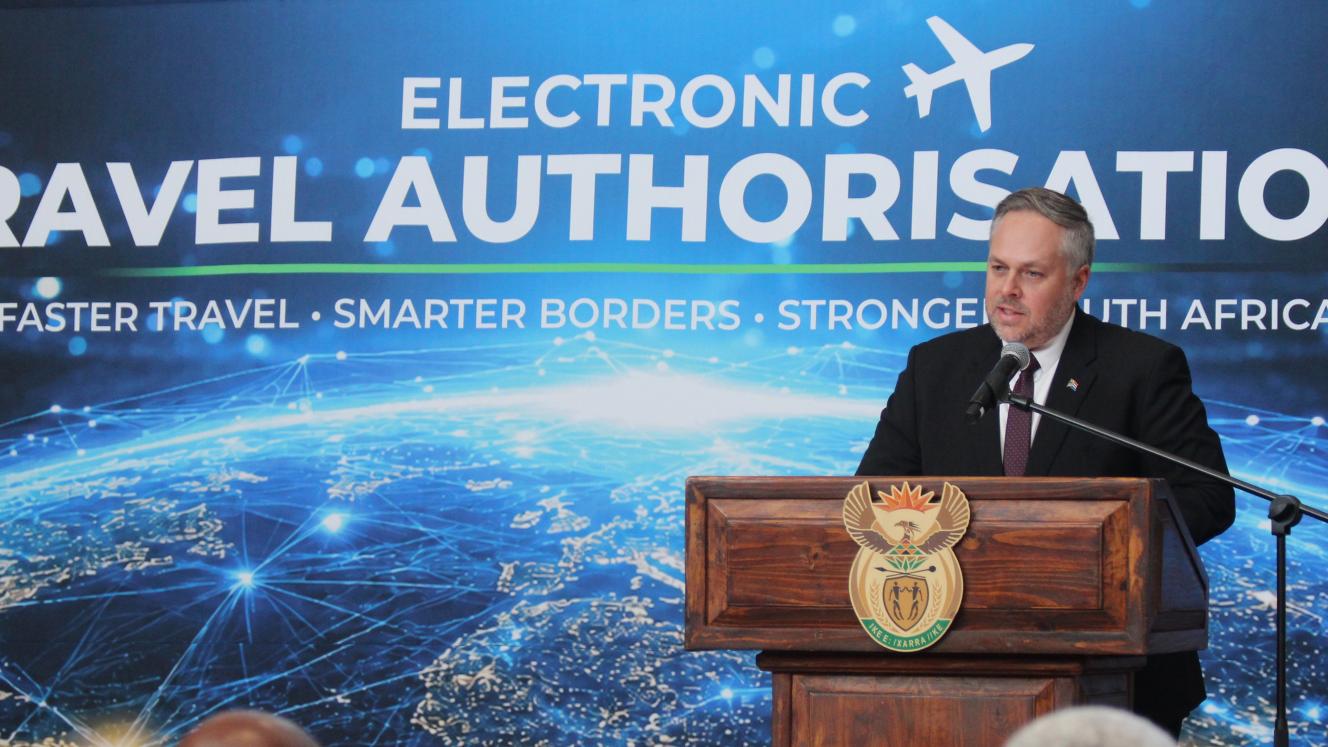
Home Affairs Minister Leon Schreiber says South Africa’s new Electronic Travel Authorisation (ETA) will not only streamline visa applications but could also offer a faster arrival experience for travellers who currently do not require visas.
However, industry stakeholders are questioning whether the system, particularly the new R500 processing fee, will deliver a sufficiently clear benefit to travellers and whether the industry has been adequately consulted ahead of its expansion.
In an interview with Tourism Update, Schreiber said visa-exempt travellers could choose to use the ETA to speed up immigration processing.
“Processing at the immigration counter is much faster under the ETA compared to the normal process because everything is pre-verified. You look into the camera then, on the back end, the system matches your face against everything pre-verified and you’re approved,” said Schreiber.
“And there’s no need for a stamp with the ETA because it’s all digitised. We think that there will be a lot of travellers from visa-exempt countries who will want a faster experience at the airport.”
Traveller confusion
Candice Magen, Founder and Director of Abroadscope and Visas Abroad, said the key question is whether travellers will understand the benefit they are receiving in exchange for the proposed fee.
“Travel is psychological. People want certainty and simplicity. If someone is planning a holiday and sees another application, another approval and another fee before they can travel, it creates friction.
“The key issue is not necessarily the amount of the fee. It is whether travellers understands what they are paying for and what they get in return.”
If the ETA genuinely removes the need for physical appointments, reduces paperwork, eliminates unnecessary outsourced costs, provides faster processing and gives the traveller certainty before departure, then there is a clear value proposition, argued Magen.
However, she pointed out, the travel industry is not clear on whether the benefits are forthcoming – they are being asked to explain a process to clients that has yet to be fully explained to them.
“The rules, responsibilities, timelines and outcomes are still unclear. What exactly are travellers getting for the R500 processing fee? Are they getting faster immigration clearance? Are they getting priority processing? Are they getting confirmation before departure that they meet South Africa’s entry requirements? Does it reduce their time at the airport? Does it provide some form of measurable assurance that they will be admitted?”
Schreiber pointed to the ETA’s planned extension module as another potential benefit. If travellers from a visa-exempt country, such as the US or Germany, wish to extend their stay beyond 90 days, they will be able to apply for a 90-day extension on the same platform within minutes.
The extension module is part of Schreiber’s broader vision for the ETA as a single-entry point for South Africa’s visa system. The launch is part of a phased rollout that began in September 2025 ahead of the G20, initially covering travellers from China, India, Indonesia and Mexico. According to Schreiber, tourist visas are only the beginning.
“Our end date is to bring every visa application into the ETA. We will not have any kind of standalone system whether it’s eVisa or Trusted Tour Operator Scheme or anything else. Everything will come into the ETA.”
Consultation questioned
Schreiber said Home Affairs has engaged extensively with stakeholders, including discussions with Tourism Minister Patricia de Lille, the Immigration Advisory Board and the public consultation process.
However, Magen believes the engagements were not sufficient, particularly for those expected to communicate the changes directly to travellers.
“There has been very little meaningful communication with the industry about the proposed ETA fees, how the system will operate in practice, when travellers will be expected to pay or exactly what the traveller receives in return for that payment.”
She said there are too many unanswered questions to confidently support the system and the deadline to communicate these queries was extremely tight.
“We are not opposed to the ETA or to modernising the immigration system. In fact, we support moving towards a properly digital, transparent and efficient immigration process. But the industry needs to be brought into the conversation.”
When asked if he expects any issues with the system handling increased traffic after the launch, along with the inclusion of the payment gate, Schreiber expressed confidence that, even with any teething problems, the ETA process will still be vastly superior to its predecessor.
“We’ve done 216 000 applications since October. We’ve prevented or rejected 6 100 fraudulent applications or non-qualifying applications. We’re testing the payment gateway, which is the last piece of the puzzle. I don’t really foresee any major issues because we’re also doing it in a phased manner.”
Magen said the industry is not opposed to digitisation but warned that technological advances could not be a substitute for transparency and clear processes.
“South Africa needs to make international travel into the country easier – not create the perception that it is becoming more complicated and more expensive.
“And, when there is confusion at the airport, travellers don’t blame the regulation. They blame South Africa.”