
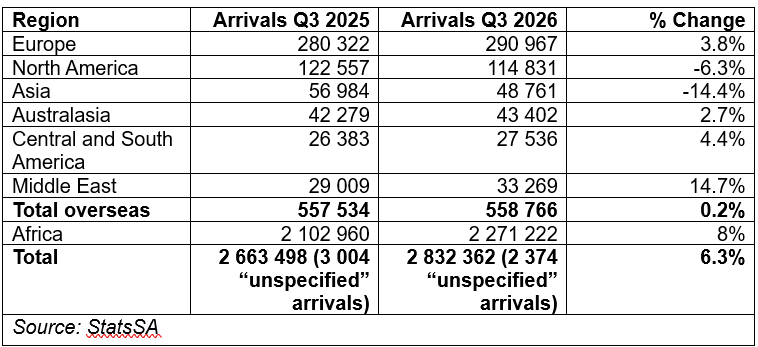
Between July and September, overseas arrivals in South Africa increased by just 0.2% compared with the third quarter (Q3) of 2025, according to the latest International Tourism Report from Statistics South Africa (StatsSA).
Europe and North America remained South Africa’s largest overseas source regions, recording 290 967 and 114 831 arrivals respectively. However, while arrivals from Europe increased by 3.8% year on year, those from North America declined by 6.3%.
The Middle East recorded the strongest growth among overseas regions. Arrivals increased by 14.7% compared with Q3 2025. Central and South America followed with growth of 4.4% while arrivals from Australasia rose by 2.7%.
Asia was the weakest-performing overseas region with arrivals declining by 14.4% year on year. Arrivals from India and China – two of the four countries initially included in South Africa’s Electronic Travel Authorisation system – fell by 27.1% and 22.2% respectively compared with the same quarter last year.
Year to date
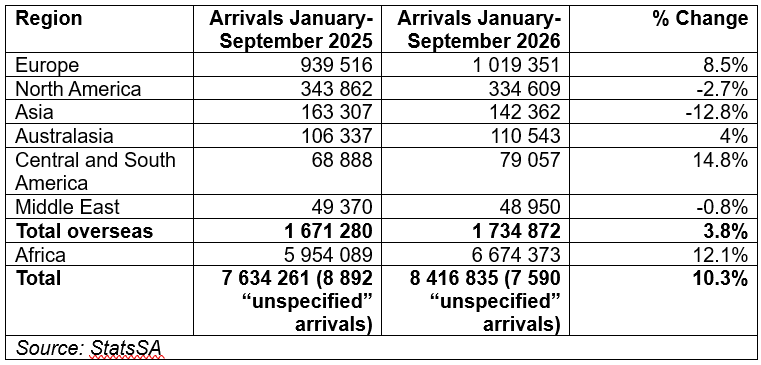
Between January and September 2026, overseas arrivals increased by 3.8% compared with the same period in 2025, driven by growth from Central and South America (14.8%), Europe (8.5%) and Australasia (4%).
Over the same nine-month period, arrivals from Asia recorded the steepest decline among overseas regions, falling by 12.8% year on year. North America recorded a 2.7% decline while arrivals from the Middle East decreased by 0.8%.
Pre-pandemic recovery
The recovery in overseas arrivals compared with pre-pandemic levels remains uneven.
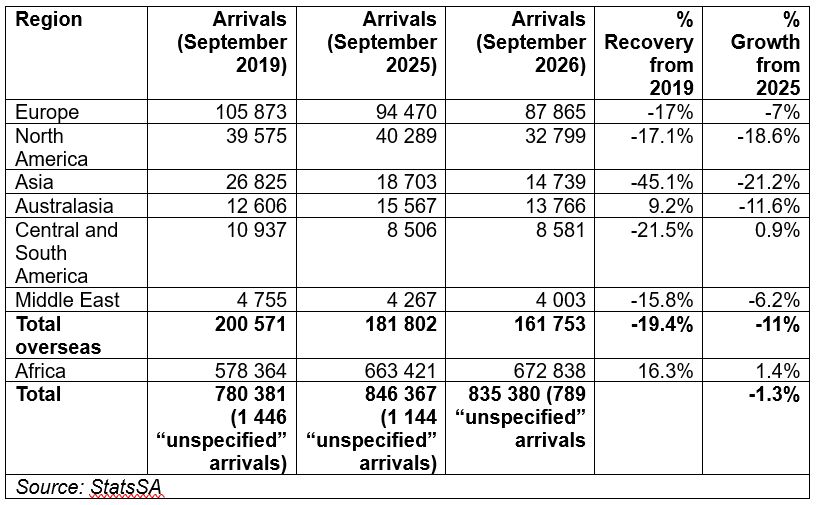
Despite total arrivals increasing by 7% between September 2019 and September 2026, overseas arrivals remained 19.4% lower over the same period with most overseas regions yet to recover to pre-pandemic levels.
Asia lagged furthest behind with arrivals 45.1% below September 2019 levels. Central and South America was 21.5% lower while North America and Europe were down 17.1% and 17% respectively.
Australasia was the only overseas region to exceed its September 2019 arrivals, recording growth of 9.2%.
Concerns around core market declines
Lee-Anne Bac, Partner: Strategic Development and Advisory at BDO South Africa, says the September figures are disappointing, particularly arrivals from North America and Asia.
“North America is an especially important market for South Africa and we need to understand what is driving the decline and how we can respond.”
Bac believes the effects of geopolitical tensions and Middle East disruptions are now starting to show more clearly.
“It could be a delayed impact. People book their trips in advance, so some travellers would already have committed to visiting South Africa before certain geopolitical developments came into play. Some may have cancelled, which could explain the smaller declines we saw previously, but we may now be seeing a more pronounced effect.”
She also questions whether airfares and fuel prices are contributing to the problem. “South Africa is a long-haul destination, particularly for visitors from the US, and the cost of getting here can have a significant impact on travel decisions.”
The September figures for the UK are also concerning, says Bac. Arrivals from the UK totalled 22 305, representing a decline of 12.6% year on year and approximately 20% below September 2019 levels. August was also weak, with arrivals down by around 15% year on year.
Germany was approximately 28% below its September 2019 level, according to the figures analysed by Bac.
“Across several overseas markets, arrivals remain significantly below pre-pandemic levels, which suggests that air access and affordability could be broader challenges rather than issues affecting only one market.”
Looking at September 2026 compared with September 2025, the UK was down by around 13%, Germany by 4%, France by 11%, Italy by 13% and the Netherlands by approximately 5%.
Russia was also down by 7%, which is noteworthy because it had been growing consistently. Canada declined by 21%, while Mexico recorded a substantial drop. Australia was down by around 12.5%.
The Far East remains a significant challenge. “India and China receive considerable attention because of their size, but we also need to consider other Asian markets, including Malaysia, South Korea, the Philippines, Taiwan and Indonesia,” says Bac.
She adds that India was down by approximately 32% and China by 27% year on year in September, while Malaysia, South Korea, the Philippines and Indonesia also recorded declines.
“These are substantial markets with large economies, and we should be looking more closely at what is happening across the region.”
The African figures are also worth examining more closely. Although arrivals from Africa increased by 8% in Q3, much of that growth was driven by the Southern African Development Community (SADC) region.
“We are seeing a different picture in some longer-haul African markets. The figures I was reviewing showed declines in arrivals from Ghana, Kenya and Nigeria, among others. Ghana was down by approximately 42%, while Nigeria had declined by around 39–40% year on year.
“These are important markets because visitors from countries such as Ghana and Nigeria can include business travellers and other higher-spending visitors. They are markets South Africa should be attracting,” says Bac.
The longer-term figures also show some weaknesses. Year-to-date arrivals from Angola were approximately 37% below 2019 levels, while Nigeria remained around 39% below its pre-pandemic level. Ghana was still above its 2019 level despite the more recent decline.
“The xenophobic attacks may be having an impact, but we would need more evidence to establish how much of the decline can be attributed to perceptions of safety and welcome.”
With these figures, Bac is not confident that South Africa will reach its target of 3.8 million overseas arrivals by next year without a significant improvement in performance.
“We need to consider what can be done to achieve that target. It is not simply a matter of making up the shortfall; we need to understand which markets can deliver additional visitors and what interventions would help us attract them.”