South Africa remains firmly on the international tourism radar but fewer travellers are positive about visiting the country or willing to recommend it to others.
This was the warning from Sithembile Ndaba, Chief Marketing Officer of SA Tourism, at the TBCSA Tourism Leadership Conference in Sun City where she presented research showing a decline in the country’s international destination sentiment between 2022 and 2025.
According to the December 2025 findings of SA Tourism's purchase journey research, awareness of the destination remained unchanged at 68% compared with 2022. However, positive sentiment declined from 40% to 37% while willingness to recommend South Africa fell from 17% to 13%.
Ndaba identified three principal barriers preventing travellers from choosing South Africa:
- The growing appeal of competing destinations
- Personal safety concerns
- An uncertain political climate
She also highlighted negative media coverage and travel advisories, insufficient use of digital channels and visitor advocacy as well as lack of coordination in destination marketing as challenges for the industry.
Converting interest into bookings
Ndaba said, although interest in visiting South Africa remains, the challenge is converting that interest into actual trips. “Travellers are taking longer to plan their visits. Whereas people might previously have planned a trip 18 months in advance, they are now becoming more cautious about planning trips to South Africa.”
David Frost, CEO of SATSA, also raised concerns about South Africa’s tourism performance, questioning the accuracy of international arrival figures as a reflection of the country’s recovery.
According to StatsSA, January to August 2026 arrivals recovered to 94.8% of the level recorded during the same period in 2019. While the results are encouraging, Frost warned that the industry must view the numbers with a degree of caution.
He highlighted the potential double-counting of international arrivals, considering some travellers use South Africa as a gateway to neighbouring destinations before returning to the country.
Analysis by some of SATSA’s destination management company members suggests that almost a quarter of arrivals in the relevant dataset may be double-counted. Frost said this could mean South Africa’s arrival figures are overstated by an estimated 12.5%.
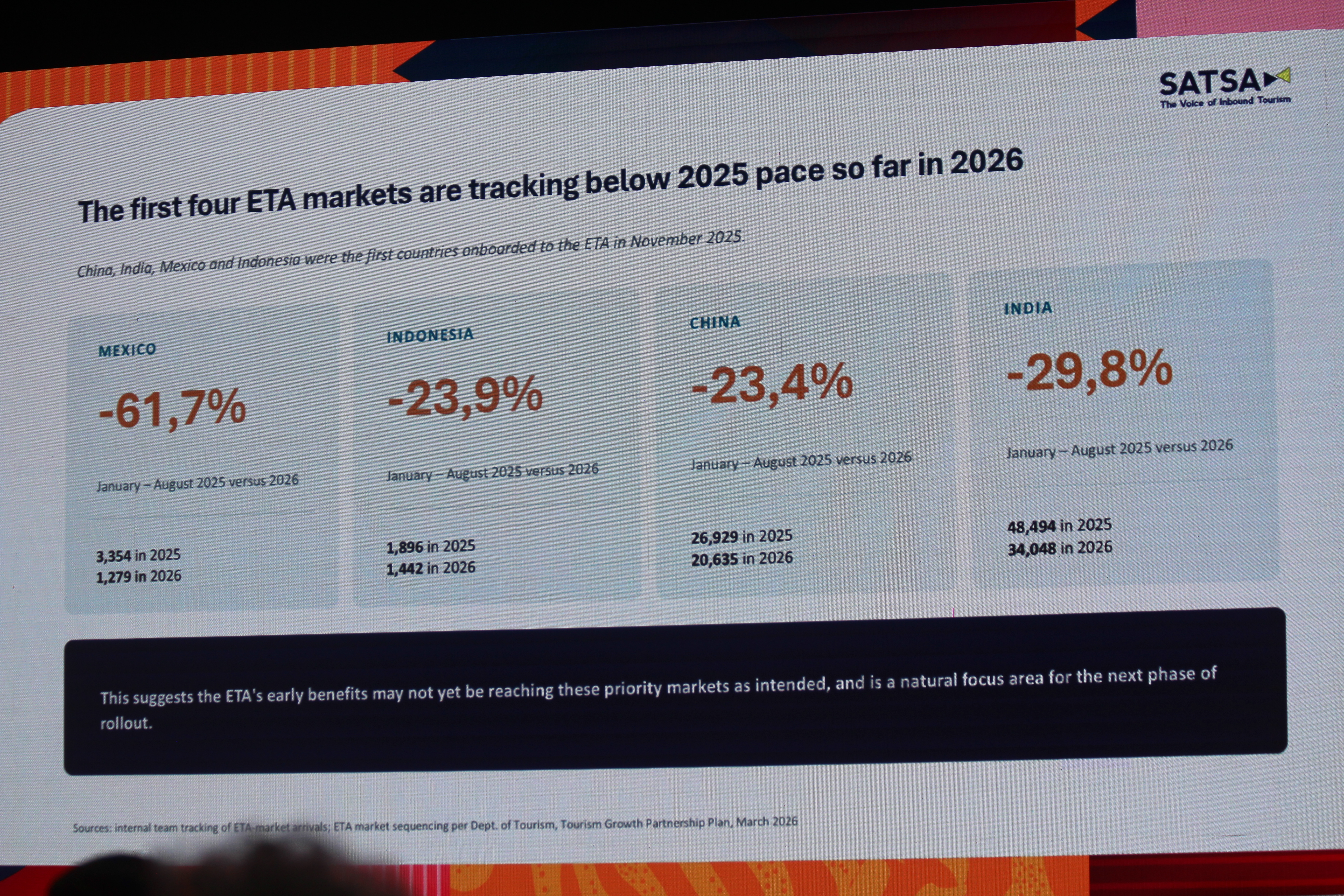
Frost also questioned the success of the Electronic Travel Authorisation (ETA) system in delivering the expected results. Despite its introduction, arrivals from the four markets tracked by SATSA remained below their January-August 2025 levels.
SATSA’s figures show that arrivals from Mexico declined by 61.7% year on year, followed by Indonesia (-23.9%), China (-23.4%) and India (-29.8%).
Frost said SATSA will host a workshop with the Department of Home Affairs on November 5 to address the ETA system and the Trusted Tour Operator Scheme.
Five pillars for tourism growth
Frost also outlined how TOMSA has used accumulated funds to support a coordinated destination marketing plan structured on five pillars:
- Priority markets identified by SATSA and SA Tourism for closer engagement: the UK and Ireland, North America, German-speaking Europe, China, India and Africa
- Developing niche sectors, including adventure and youth travel
- Brand campaigns and destination competitiveness, including the recent TBCSA campaign featuring Trevor Noah
- Events, including Cape Town Pride in 2028 and the Icons Cup South Africa, as potential tourism drivers
- Joint marketing agreements with international operators to stimulate additional demand