
While South Africa’s inbound tourism recovered overall in April, recovery from long-haul markets remained uneven.
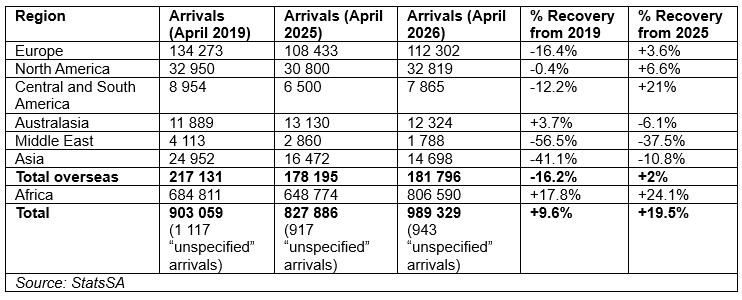
According to the latest International Tourism Report from Statistics South Africa (StatsSA), the country’s total tourist arrivals for April continued to outperform pre-COVID levels with volumes rising by 9.6% compared with 2019 levels. There was also an increase of 19.5% compared with April last year.
However, total overseas arrivals were relatively flat year-on-year, increasing by just 2% and remaining 16.2% below April 2019 levels.
The latest performance was driven almost entirely by the African market, which increased by 24.1% compared with April 2025 and was 17.8% higher than in April 2019.
North America almost fully recovered at just 0.4% below 2019 volumes while Europe was down by 16.4% on pre-pandemic levels despite modest annual growth of 3.6%.
Central and South America showed one of the more dynamic recovery profiles among long-haul source markets. Arrivals recorded a sharp 21% year-on-year increase. However, April volumes remained 12.2% below April 2019 arrivals.
Asia remained the weakest long-haul performer down 41.1% on 2019 levels and 10.8% behind 2025.
India was one of the most concerning underperformers in South Africa’s long-haul recovery mix. Arrivals fell from 5 627 in April 2025 to 4 158 in April 2026 – a steep 26.1% year-on-year decline. Against the 2019 baseline of 8 534 arrivals, India was 51.3% below pre-pandemic levels.
Middle East arrivals fell by 37.5% year-on-year and 56.5% compared with 2019.
Australasia edged slightly above 2019 levels, increasing by 3.7%, but, down 6.1%, remained volatile on a year-on-year basis.
Here is the full breakdown:
Commenting on the latest figures, Martin Jansen van Vuuren, MD of Futureneer Advisors, told Tourism Update that the growth in Africa’s share of South Africa’s inbound arrivals between January and April was primarily driven by strong performance from high-volume neighbouring markets.
Jansen van Vuuren cautioned that overseas demand may remain under pressure as the conflict in the Middle East continues to disrupt long-haul travel patterns and add to aviation costs.
“Higher fuel prices and related airfare pressures could have a longer-lasting effect, particularly in key markets in Europe and Asia, where travellers have a wide range of shorter-haul alternatives and may defer long-haul trips.
“This appears to be reflected in markets such as India where a combination of higher travel costs, inflation and broader economic uncertainty may be encouraging travellers to choose regional destinations such as Vietnam, Thailand, Malaysia and Japan over long-haul travel.”
South Africa’s long-haul inbound market remains heavily concentrated in a few key source countries, he added.
The data also highlights South Africa’s continued dependence on three key overseas source markets – the UK, US and Germany – which together account for about 41% of overseas tourists. In the April 2026 results, the UK and Germany declined while the US posted modest growth, Jansen van Vuuren pointed out.
By contrast, markets such as Brazil (+37.5%), Belgium (+28.5%), France (+22.2%), the Netherlands (+20.4%), Portugal (+20.6%) and Canada (+14.8%) delivered stronger gains.
Jansen van Vuuren also noted that Brazil stands out as the fastest-growing leading overseas market and the new Cape Town-Brazil air connection could help sustain that momentum.
“Brazil is already the largest source market in South America by a wide margin while Argentina and Chile contribute smaller volumes. The performance of other South American countries could be seen as an opportunity for growth,” he said.
Additionally, Jansen van Vuuren pointed to shifting geographic patterns within South Africa’s air gateway performance with Cape Town increasingly strengthening its position in the overseas market: The figures suggest that geographic spread remains uneven. Between April 2025 and April 2026, Cape Town International Airport (+20.5%) recorded growth while King Shaka International Airport (-68.7%) and OR Tambo International Airport (-8.3%) declined.
Cape Town International Airport is increasingly emerging as a key overseas entry point, he added. In April, the airport received 67 811 overseas tourists, which is about 70% of OR Tambo’s 96 490. In addition, 83% of all international tourists arriving through Cape Town International were overseas visitors compared with 59% at OR Tambo.