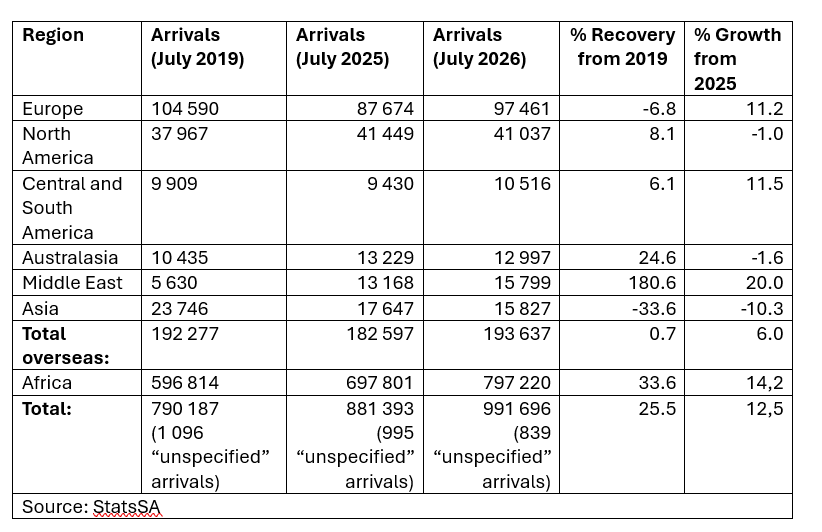
Inbound tourism arrivals saw moderate but uneven growth in July. According to the latest International Tourism Report from Statistics South Africa (StatsSA), total overseas numbers showed modest growth, increasing by 6% year on year in July and 0.7% above pre-pandemic levels.
Total arrivals in July this year were 25.5% higher than the same month in 2019 and 12.5% higher than July 2025.
European arrivals were down 6.8% compared to pre-pandemic levels but grew 11.2% year on year.
The Netherlands was the third-largest overseas source market in July, with 17 066 tourists, behind the US (37 310) and UK (25 024). It too had a noteworthy year-on-year increase (14.2%).
France was the fastest-growing of South Africa’s leading overseas markets with arrivals up 24.9% year on year to 12 496 in July.
Australia continues to be one of South Africa’s strongest long-haul markets relative to pre-pandemic levels. It was already above 2019 in the regional data and it remained one of the top five overseas markets in July 2026 with 11 068 tourists. Germany moved down to number six in the overseas ranking although arrivals from this market increased 19.0% year on year.
The Middle East market recorded strong growth in July, increasing by 20% year on year and a remarkable 180.6% from pre-pandemic levels. Gulf states are becoming meaningful contributors: Saudi Arabia supplied 7 671 tourists, making it the eighth-largest overseas market in July, while the United Arab Emirates supplied another 5 059.
According to July arrival data, Asia remains the weakest-performing overseas region with arrivals still 33.6% below July 2019 levels. Compared with July 2025, arrivals from Asia declined by 10.3%.
Southern African Development Community (SADC) countries accounted for 98.5% of African tourist arrivals in July 2026 with arrivals from the region increasing by 14.9% year on year. Outside the region, Egypt and Kenya were among the few leading markets to record year-on-year growth with Egypt increasing 12.9%. Arrivals from African countries outside of the SADC region decreased by 17.7% year on year.
Here is the full breakdown:
According to David Frost, CEO of SATSA, the stats paint a picture of international markets recovering unevenly. From January to July 2026, overseas arrivals reached 1.37 million, up 5.7% year on year and 94.7% of 2019 levels.
“Much of that recovery is coming from established Western source markets. Australia, the Netherlands, Brazil, the United States and Germany are now above pre-pandemic levels while the UK has recovered to 94.7%. The picture is very different for Asia, particularly India and China.”
Frost noted that India is at just 50.7% of 2019 levels and continues to decline year on year.
“Given the size and potential of the Indian outbound market, South Africa is not yet capturing the share it could. The Electronic Travel Authorisation is a welcome step and removes one barrier to travel but visa access is only part of the picture.”
He noted that a significant challenge in attracting the Indian market is air access.
“India is heavily reliant on Middle Eastern hubs to reach South Africa, which leaves the market vulnerable to regional disruption and pricing pressure. With the 2027 Cricket World Cup ahead and strong people-to-people links between India and South Africa, there is a strong reason to address this now.”
Frost said, for South Africa to rebuild demand from a market that remains well below its pre-pandemic levels, emphasis needs to be placed on direct air access and sustained destination marketing, which would make South Africa easier to reach and easier for the Indian travel trade to sell.